Demystifying For Leaders
Wait and See is Not an Option
The most expensive sentence in business right now sounds like caution. It isn't.
I've lost count of how many times I've heard a version of the same line in a leadership meeting. "Let's wait and see how this AI thing plays out."
It sounds careful. It isn't. It's a decision to lose slowly.
Here's what I've learned the hard way. Waiting feels like prudence because it costs nothing today. The bill shows up later, and by then it's bigger than anyone budgeted for. The same instinct told retailers the internet was a fad. It told taxi fleets an app could never matter. In a normal year, waiting is reasonable. In a platform shift, waiting is the risk.
Most leaders treat AI as a tool the IT team will roll out once it's ready. That framing is the mistake. AI isn't a tool you wait for. It's a capability your organization has to learn. And learning takes reps, which means it takes time you only get by starting.
The advantage was never in the tool
I spent fifteen years as a head football coach before I ever sat on the operator side of a P&L. That stretch taught me one thing that applies straight to this moment.
I never once won a game because I had a secret play nobody else knew. The plays were in every book. Any coach could buy the same film, run the same install, draw up the same coverage. We won, when we won, because our people learned the system faster, trusted it more, and ran it cleaner under pressure than the team across the field.
Generative AI is the same. The models are available to everyone. Your competitors can buy exactly what you can buy, the same week you buy it. The edge was never going to come from the technology. It comes from how fast your people can learn it, govern it, and turn it into a better way of working.
That's the part people miss. They go looking for an advantage in the tool. The advantage is in the team.
What actually happens while you wait
Here's what actually happens in most organizations right now. Leadership debates whether AI is real. Meanwhile the best people on the payroll are already using it, quietly, on personal accounts, with no sanctioned path. The org stays silent, so the silence reads as a threat, and your top performers go into the shadows.
You end up with the worst of both worlds. No governance, and no learning you can see.
This is where most teams get stuck. They wait for certainty before they'll move. But you don't build certainty by watching. You build it by starting small, in a bounded way, where a mistake is cheap and the lesson is real.
Where I'd start this week
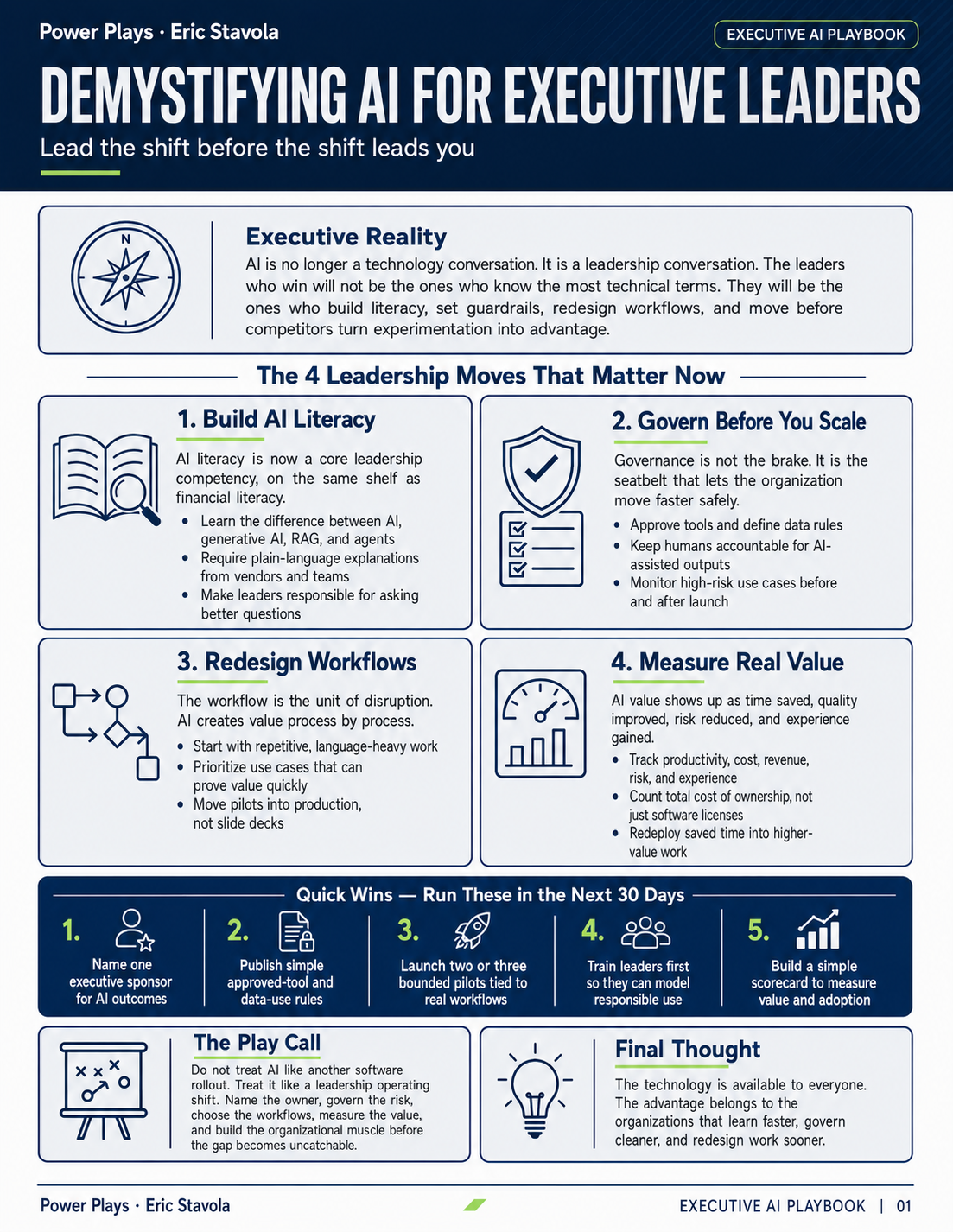
None of this requires a transformation budget or a grand reveal. It requires a few honest moves you could make before Friday.
- Name a sponsor. Decide who owns this, even if the answer is you. An effort with no owner is a hobby, and hobbies don't survive the first budget cycle.
- Give your best people a sanctioned path. They're already using these tools. The only real question is whether they're doing it in the open, where you can coach it, or in the dark, where you can't.
- Pick one bounded pilot. Not the flashiest idea in the room. The one most likely to ship and prove something real in ninety days.
- Get personally fluent. You don't need to write the model. You need to read the field well enough that no vendor can sell you fog.
- Write down what you learn. Learning speed only compounds if the lesson outlives the person who learned it.
None of these are bets. They're reps. And reps are how a team gets good at something before the pressure is on.
A year from now, the leaders who pulled ahead won't be the ones who bought the best tools. Everyone bought the same tools. They'll be the ones whose teams learned to run them while everyone else was still waiting to see.
That's always been the difference. The team