You Don't Get to Choose Whether Your Company Uses AI
Your people already made that call. CLOSED is the six-question model for leaders who'd rather lead it than pretend it isn't happening.
I was in a meeting last year where a senior leader said, with total confidence, that his company didn't allow AI yet.I didn't argue. I just looked around the room. I already knew three people at that table were using it. One had drafted the agenda we were looking at. Another was running customer emails through a tool on her personal laptop. The leader wasn't wrong about his intentions. He was wrong about his reality. Here's the part people miss. The decision to use AI in your company has already been made. Your people made it. They made it weeks ago, quietly, without asking, because the work was easier with it than without it. And that gap, between what you've allowed and what's already happening, isn't holding steady. It's widening. Every week you don't decide, your people are building habits around tools you haven't vetted, in places you can't see. Those habits harden. Wait long enough, and you're not writing a policy anymore. You're undoing one that formed without you. So the question was never "should we allow AI?"The question is whether you're going to lead it or pretend it isn't happening.
The frame most leaders get wrong
When executives talk about AI policy, they reach for two words. Open or closed.Open sounds modern. Let everyone experiment. Move fast. Trust your people. Closed sounds cautious. Lock it down. Wait for legal. Protect the company. That's the wrong fight. What most companies actually have right now isn't open or closed. It's neither. It's sprawl. Everyone improvising, no playbook, no called plays, no idea who's running what. That isn't freedom. That's a defense with no assignments.CLOSED, the way I mean it, isn't about banning anything. It's a structure that lets you move fast on purpose instead of fast by accident.Six questions. That's the whole model.
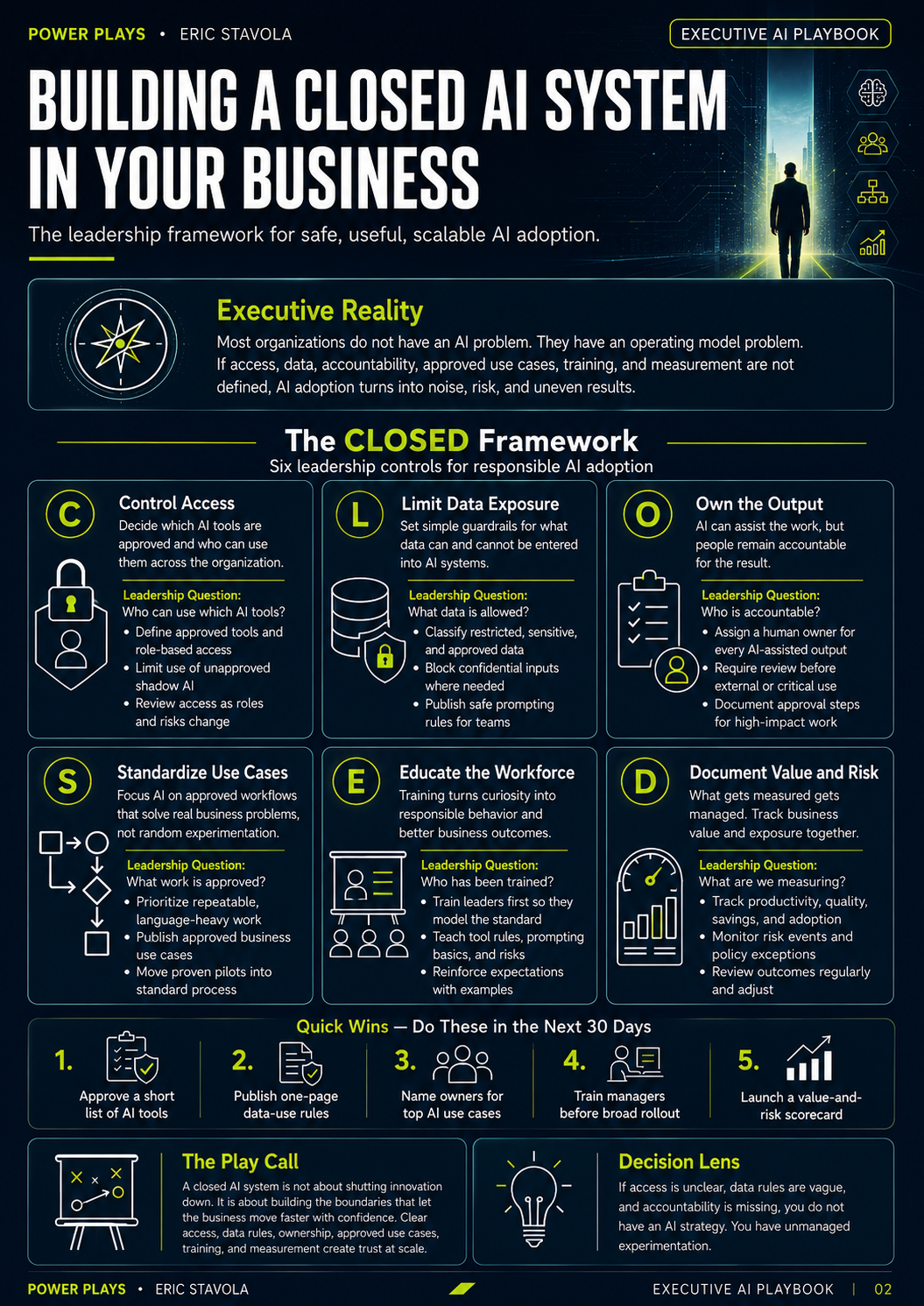
C. Control access
Who can use which AI tools? Most companies can't answer this. Not because they don't care, but because they never decided. Access happened to them. Controlling access doesn't mean one tool for everyone, or a wall around the whole thing. It means knowing who's holding what, and matching the tool to the work. Your finance team and your marketing team don't carry the same risk. They shouldn't carry the same access.You can't coach a unit you can't see.
L. Limit data exposure
What data is allowed in? I've watched someone, smart, senior, well-meaning, get one keystroke away from pasting a signed client contract into a public tool because she wanted the key terms summarized before a call. She wasn't careless. She was busy. The tool was right there, and nobody had ever told her that the contract was off-limits. That's the whole risk in one moment. The fastest way to turn a useful tool into a lawsuit is to feed it something it was never supposed to see. Client records. Contracts. Anything covered by an agreement you signed. Your people aren't trying to leak data. They're trying to finish a task. They'll paste whatever gets them there unless you've told them where the line is. Draw the line before someone crosses it, not after.
O. Own the output
Who's accountable? Here's what actually happens. A tool writes something, a person sends it, and when it's wrong, everyone points at the tool. That can't be the answer. AI doesn't take accountability. It can't sit in the meeting and explain the mistake. A name has to be attached to every piece of work that leaves the building, just as it always was. The tool changes how the work gets made. It doesn't change who answers for it. If no one owns the output, no one's leading the work.
S. Standardize use cases
What work is approved? This is the one most leaders skip, and it's the one that actually creates speed. Not by opening everything. By being clear about what's already a yes. Think about how your people experience an undecided policy. They've got a task in front of them and a tool that could do it. No one's told them whether it's allowed. So they make a quiet bet. The cautious ones freeze and do it the slow way, and you lose the speed you're paying for. The bold ones freelance, and you lose the control you thought you had. Either way, every person is privately writing their own policy, and none of them match. A short list of approved plays ends that. Drafting. Summarizing. First-pass analysis. Research cleanup. When the answer is already a yes, people stop guessing and start moving in the same direction. Here's the part that surprises people. Clarity is faster than permission. A vague warning makes everyone slow down to protect themselves. A clear yes lets them go. Most leaders think the brake is what keeps them safe. The brake is what keeps them slow. That's the misread at the center of this whole thing. People hear "closed" and picture friction. Done right, closed is the green light. It's the difference between a team that knows the play and a team standing around waiting to be told they won't get in trouble.
E. Educate the workforce
Who's been trained? A tool in untrained hands isn't an advantage. It's exposure.Most companies buy the license and skip this part entirely. They assume people will figure it out. Some will. Many will use it badly and never know it, trusting answers they should have questioned, missing the places where it's confidently wrong. Training isn't a one-time slide deck. It's how your people learn to tell good output from output that just looks good. The team that learns faster wins. That's been true of every tool I've ever worked with, and it's truer now than ever.
D. Document value and risk
What are we measuring? If you can't say what AI is doing for you, you can't lead it. You can only hope. Document both sides. Where is it saving real time? Where is it creating real risk? What's working, what almost went wrong, what you'd do differently. This isn't a compliance exercise. It's how you find out whether any of this is actually worth it, and how you make the case to keep investing when someone asks you to prove it. What you don't measure, you can't defend.
What this actually asks of you
Strip the framework down, and here's what's left.
- Decide who can use what, and write it down. Ambiguity is the policy until you replace it.
- Tell your people what data is off-limits before they guess wrong.
- Attach a name to every output. Accountability didn't move.
- Make a short list of approved uses. A clear yes moves faster than a vague warning.
- Train people to question the tool, not just trust it.
- Measure the value and the risk so you can lead with facts rather than fear.
None of this requires you to be a technologist. It requires you to lead.
The quiet part
AI doesn't fix a broken system. It moves faster through whatever system you already have. If your team is sharp and your standards are clear, you become faster. If your team is loose and your lines are blurry, it makes the mess faster, too.CLOSED isn't about slowing down. It's about earning the right to go fast. Your people already opened the door. The only question left is whether you walk through it leading, or follow them in still pretending you didn't see it open.